Undetected structural failure
Cracks, included bark and internal decay are often invisible to an untrained eye until the tree has already failed.
Tree inspections & surveys
Before you decide whether a tree needs reducing, removing or leaving alone, you need an honest look at its actual condition, not a guess from the pavement. We carry out a visual tree assessment on site, then write the findings up in a report and send it to you.
12 years assessing tree condition and risk, 59+ five-star Google reviews, basic surveys from £50 per tree.
12 yrs
Assessing tree condition, risk and structural defects across the borders
£15m
Total insurance cover, £10m employers', £5m public and products
NPTC
City & Guilds certificates in felling, climbing and aerial rescue
£50
Starting price per tree for a basic visual inspection, written up and sent to you
The service
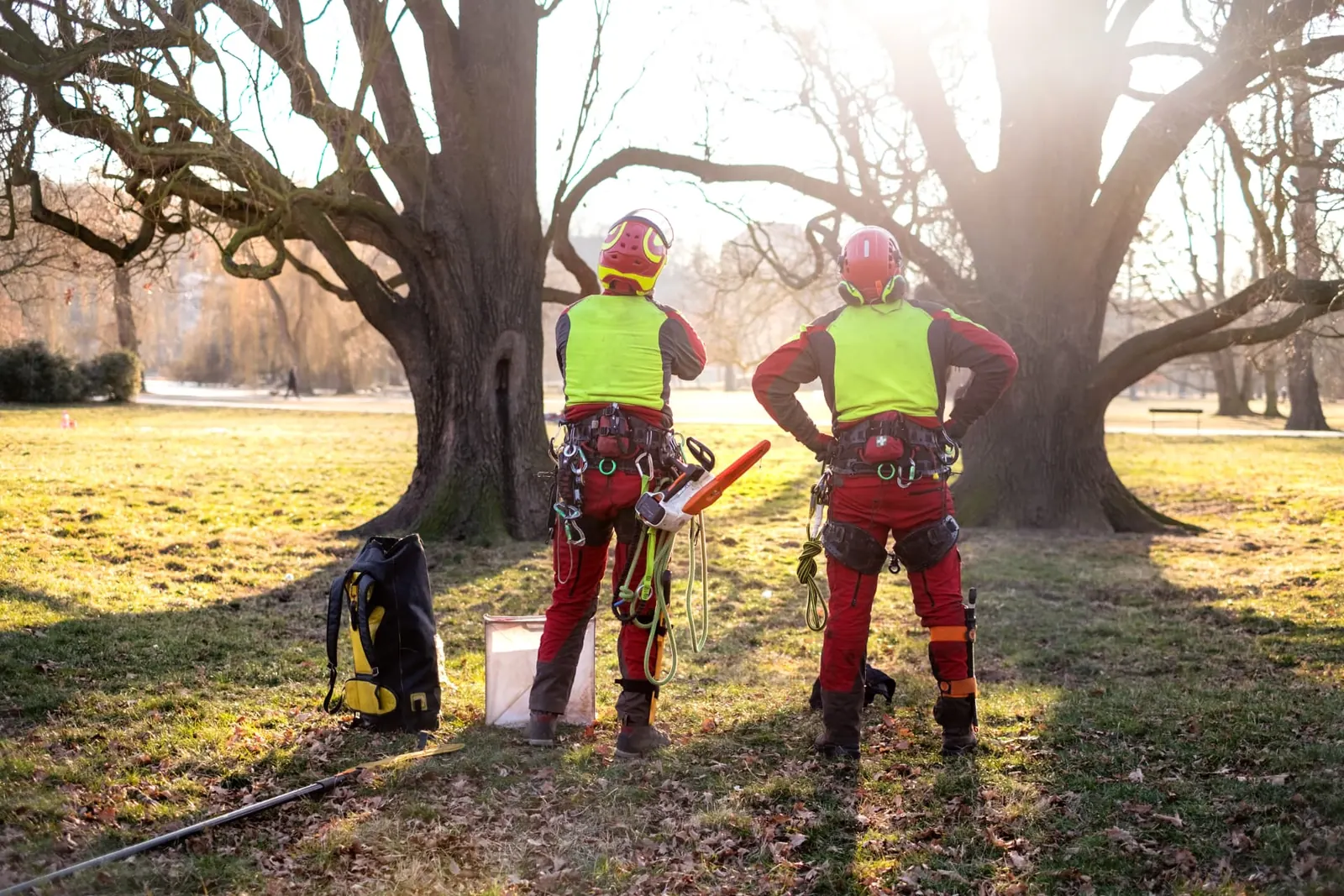
A tree inspection is a visual tree assessment, or VTA, a systematic look at a tree's crown, stem and root plate from the ground, checking for deadwood, cracks, included bark at unions, fungal fruiting bodies, cavities, lean, and any signs the tree is under stress. It is a basic visual condition inspection, not a formal engineering report, and the findings are written up clearly and sent to you so you have something in hand for insurers, buyers, solicitors or your own peace of mind.
It is the survey homeowners ask for when a tree is dropping deadwood and they want to know if it is a hazard, when a mortgage lender or insurer has flagged a tree near a property, when buying a house with mature trees on the plot, or when a landlord or managing agent needs to demonstrate reasonable care has been taken over trees on a site with public access. It is also used simply to get an honest second opinion on a tree before spending money reducing or removing it.
Where a lender, planning authority or insurer specifically requires a full BS5837 arboricultural report or a formal mortgage valuation report, that is a different, more detailed piece of work with its own methodology, we can discuss what that requirement actually involves at the site visit, and point you toward it if a basic inspection isn't what's being asked for. Jack holds NPTC and City & Guilds certificates in tree work and inspects with a working knowledge of how trees fail, backed by £10m employers' liability and £5m public and products liability cover.
Homeowners, landlords, managing agents, buyers and sellers, and anyone needing a documented opinion on a tree's condition.
Deadwood or dropped limbs, concerns raised by an insurer or lender, before buying a property with mature trees, or before deciding on further tree work.
A ground-level visual assessment of crown, stem, unions and root plate, written up and sent to you as a report.
Not a formal BS5837 or mortgage-valuation report, where one of those is specifically required, we'll discuss it with you at the visit.
What happens if it's left
Very few tree failures happen with no warning at all. A crack widening quietly at a union, a fungal bracket appearing low on the trunk, a crown that has thinned unevenly, deadwood accumulating year on year, these are all visible signs, but only if someone who knows what they're looking at actually stops to check. Left unexamined, a tree with early signs of decay looks completely normal to most people right up until a limb comes down or the whole stem fails.
Occupancy and target risk make this worse than it sounds. A declining tree over a quiet corner of a field is a low-priority watch item. The same tree over a driveway, a play area, a public footpath or a neighbour's garden is a different level of risk entirely, and it is exactly the kind of distinction an insurer or a court will expect a landowner to have thought about if something does go wrong.
The mistake we see most is people either ignoring an obviously declining tree because it 'seems fine so far', or going the other way and paying for extensive, expensive work on a tree that a proper inspection would have shown was perfectly sound. Both come from the same root cause: no one having actually looked at the tree properly and written down what they found.
Cracks, included bark and internal decay are often invisible to an untrained eye until the tree has already failed.
Bracket fungi and other decay indicators at the base or on the stem signal internal rot that has often been developing for years.
Without a written record of a tree's condition, disputes over liability or property sales become harder to resolve favourably.
Without a proper assessment, trees are sometimes reduced or removed unnecessarily, at real cost, when targeted work would have done.
Landlords and site owners with public access have a duty of care, and no record of inspection weakens their position if a tree does fail.
Ordering the wrong type of report, a basic inspection where a formal BS5837 survey was actually required, or vice versa, wastes time and money.
How we do it
01
You tell us how many trees need inspecting and why, insurer request, pre-purchase, general concern, so the right approach is used.
02
Jack visits, usually within 7 days, and carries out a ground-level visual tree assessment of each tree's crown, stem and root plate.
03
Any immediate hazards are flagged to you directly on the day, rather than waiting for the written report to arrive.
04
Findings for each tree are written up clearly and sent to you, along with a written quote for any recommended work.
05
If the report identifies work required, it can be booked in directly, with TPO or conservation-area applications handled on your behalf.
What you get
Findings are discussed with you at the visit, not held back until a report arrives days later.
A clear written report for insurers, solicitors, buyers or your own file, documenting condition at the time of inspection.
From £50 per tree, up to £250 for anything up to 10 trees, then £7.50 per tree after that, a transparent structure for multiple trees.
A proper assessment avoids paying for reduction or removal work that a genuinely sound tree doesn't need.
Carried out by someone who holds NPTC and City & Guilds certificates and has spent 12 years working directly on trees, not just observing them.
If work is needed, it can be quoted and booked straight from the same visit, including any TPO or council applications.
A visual tree assessment is a structured look at specific parts of a tree in a specific order, not a general glance. Here is what an inspection actually checks and how the findings get used.
A VTA works systematically from the base of the tree upward: root plate and buttress roots first, checking for heave, cavities, fungal fruiting bodies or soil cracking that might indicate root failure; then the trunk, looking for cracks, cavities, included bark, old wounds, sap runs and the presence or absence of a healthy bark surface; then the crown, assessing deadwood, dieback, weak or included unions between major limbs, and the overall density and symmetry of foliage.
The assessment is carried out from the ground using binoculars where needed rather than by climbing the tree, which is standard practice for this type of visual inspection. Anything that raises a genuine concern about imminent failure is flagged to you directly on the day rather than waiting for the written report.
Deadwood is graded by size and location rather than treated as a single category, small twig dieback at the crown edge is normal and low risk, while a large dead limb over a path or drive is a priority. Cracks are assessed for depth, whether they run with the grain, and whether there's evidence of movement, such as fresh bark reaction at the edges.
Included bark, where two stems or major limbs have grown together with bark trapped between them rather than forming a strong structural union, is one of the most common causes of sudden limb failure in mature broadleaf trees, and it's frequently invisible until you know exactly where to look for the tell-tale seam running down from the fork.
Fungal fruiting bodies at the base or on the stem, brackets, mushrooms or other visible fruiting structures, indicate that decay fungi are active somewhere in the root or stem wood, though the exact extent of internal decay isn't always visible from the outside. Different species indicate different patterns and severity of decay, and their position on the tree matters as much as their presence.
Honey fungus is one of the more serious indicators, spreading through root systems and often visible as black, root-like rhizomorphs under bark or in the soil, or as clusters of honey-coloured toadstools at the base in autumn. Where it's suspected, this is flagged clearly in the report, as it affects not just the tree in question but potentially neighbouring trees too.
The same defect on the same tree carries very different real-world risk depending on what's underneath it. A weak union over open ground carries low occupancy risk; the same union over a driveway, a children's play area or a public footpath carries a much higher one, because failure there is far more likely to cause harm or damage. Target and occupancy assessment is built into the report alongside the physical condition findings, because risk is really a combination of both.
This is particularly relevant for landlords, managing agents and anyone with public access across their land, where a documented, risk-graded record of tree condition supports the duty of care they're expected to show.
The written report covers each tree inspected, its species, general condition, any defects found, an assessment of priority, and recommendations, whether that's no action needed, monitoring, or specific work such as deadwooding, reduction or removal. Basic inspections start from £50 per tree, rising to £250 for anything up to 10 trees on one visit, then £7.50 per tree after that.
Where a lender, planning authority or insurer specifically requires a full BS5837 arboricultural survey, the standard used for development sites and formal mortgage valuations, with its own detailed methodology and root protection area calculations, that's a distinct piece of work outside the scope of a basic visual inspection. If you're not sure which you need, mention the exact requirement when you book, and we can talk it through at the site visit.
Questions
Related work
A Tree Preservation Order or a conservation-area designation does not mean a tree can never be touched, it means the council needs to be asked first, in writing, with a proper case made.
Dead and hanging limbs don't announce themselves before they fail.
A tree that has split, is partially uprooted, or is leaning further than it should is not a job to approach without a proper plan.
We cover Oxted, Westerham, Edenbridge, Sevenoaks, Biggin Hill, Bromley, Tunbridge Wells, Redhill and the surrounding villages, see the towns our tree surgeons cover across Surrey and Kent, browse all tree surgery services, read about Jack and the crew, or go straight to the free tree surgery quote form.
Free quote
Send the form or call 07375 701290 and we will book a free site visit, usually within 7 days. You get an honest on-site opinion and a written report sent to you, with any recommended work quoted the same day.
Call 07375 701290Five Pebble Hill Cottages, Westerham Road, RH8 0EA · Mon–Sat 8am–9pm · Sunday closed
We use essential cookies to run this site, plus optional ones for maps and chat. Cookie policy